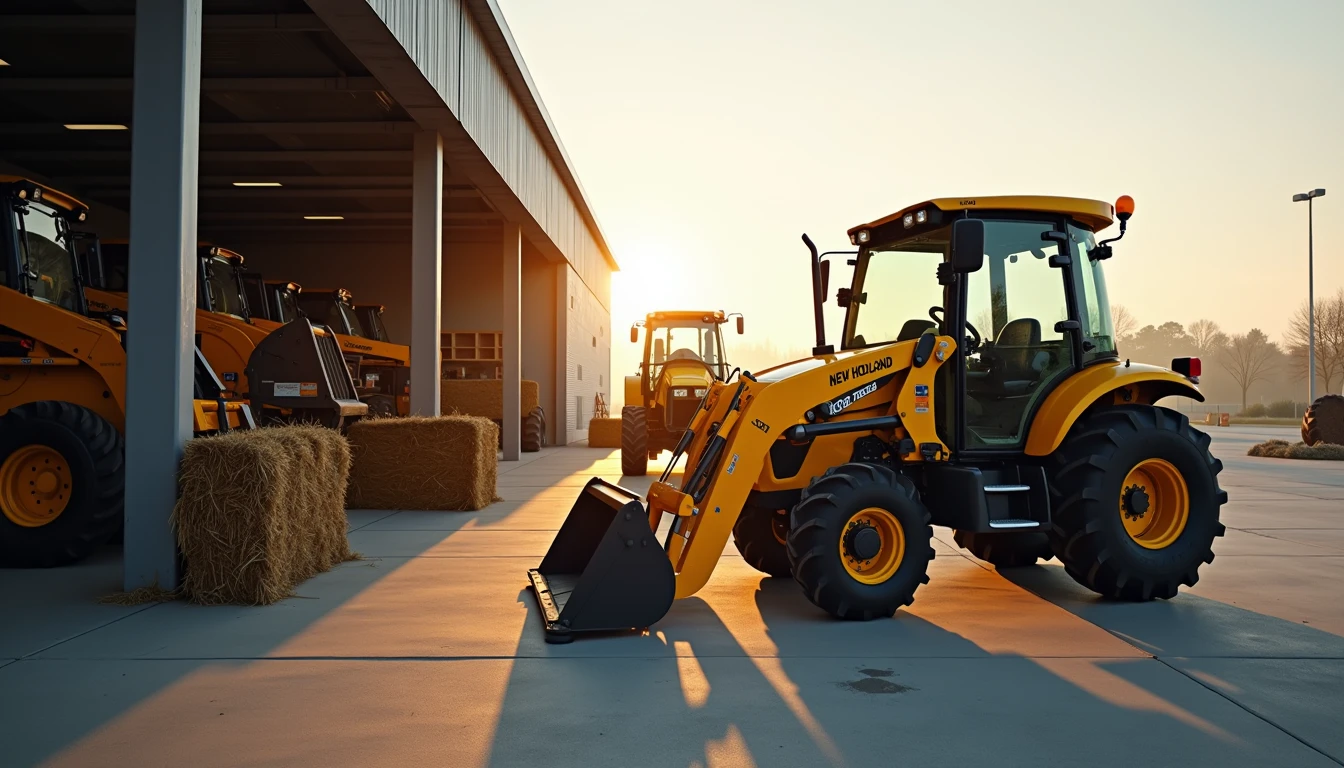
New Holland pushes mid-2026 incentives and spec-compare tools to reduce equipment selection risk
The Big Picture
A guy brought in his truck last week and said, “Luis, I can’t afford downtime—my whole week gets sideways.” Same story on the ranch: if the tractor’s down when the weather window hits, you don’t just lose time—you lose yield and cash. For fleet managers and farm operations leaders, New Holland’s current push is less about one single machine and more about controlling total cost of ownership (TCO) through smarter purchasing decisions, tighter preventive maintenance planning, and faster access to local inventory.
Based on New Holland’s agriculture site, the company is emphasizing three business levers decision-makers care about: (1) dealer-local inventory visibility (“Shop Inventory”), (2) time-bound purchase incentives (“Get big cash back or 0% financing… offers end June 30, 2026”), and (3) selection-risk reduction via digital tools (“Compare Specifications” and “Build & Price”). In a market where uptime is the product, these are practical levers to reduce procurement cycle time and avoid mismatched equipment that can drag down utilization.
Key Details
New Holland’s site highlights broad coverage across agricultural and light construction categories, positioning the brand as a one-stop supplier across multiple fleet types:
- Tractors & Telehandlers: Positioned as a complete horsepower-range offering (“No matter what horsepower you need, we have the tractor for you.”).
- Haytools & Spreaders: Mowers to balers and related tools (“complete line of haytools”).
- Forage Harvesters: Emphasis on chop quality, maintenance accessibility, and efficiency (“best-in-class chop quality, easy maintenance and high efficiency”).
- Combines & Headers: Marketed on capacity and grain quality (“record-breaking capacity and quality”).
- Spraying Equipment: Focus on drift reduction and visibility (“front boom,” “reduced drift,” “unmatched visibility”).
- Seeding Equipment: Targets accuracy and efficiency (“Accuracy matters… higher efficiency.”).
- Grape & Olive Harvesters: Points to productivity and gentle handling for quality preservation.
- Light Construction Equipment: Mini and midi excavators, skid steer loaders, loader backhoes, and more—framed as jobsite-capable solutions.
- Material Handling: Equipment to “spread, cut, level and move” material.
- Front Loaders & Attachments: Implements including rotary cutters, front loaders, and blades.
- Precision Technology: “Precision solutions” to improve operational efficiency and profitability.
Two specific compact tractor lines are repeatedly promoted for exploration:
- WORKMASTER 35C & 40C compacts
- T7 Series
For procurement teams, the most actionable elements are:
- Promotional financing/cash programs: “Get big cash back or 0% financing on select tractors, haytools and more.” The only hard constraint provided is timing: offers end June 30, 2026.
- Dealer-local inventory search: “Explore local New Holland inventory from dealers near you.”
- Digital selection tools: “Compare Specifications” and “Build & Price” are positioned to simplify research and configuration.
Shop Trick (three generations): Before you even compare specs, write down the three numbers that actually drive your cost per hour: required duty cycle, attachment/interface needs, and service support distance. My grandfather used to say, “A machine you can’t service fast is a machine you can’t afford.” The website’s inventory locator and compare tools are only valuable if you start with those constraints.
Operational Impact
While the source does not provide service intervals, fuel consumption, payload capacities, or model-by-model specifications, it does outline a procurement workflow that can improve operational outcomes if implemented with discipline.
1) Faster procurement and fewer mis-spec purchases
Using Compare Specifications and Build & Price can shorten the spec-definition phase and reduce “apples-to-oranges” comparisons across teams. For mixed fleets (row crop + hay + material handling, or farm + light construction), standardizing how teams compare machine categories can reduce internal friction and speed approvals.
Fleet manager takeaway: Build a repeatable equipment selection checklist around these tools. Even without published numbers here, the business value is in consistency: consistent comparisons reduce the likelihood of buying a unit that later requires expensive retrofits or gets sidelined due to capability gaps.
2) Inventory visibility supports uptime planning
“Shop Inventory” and dealer-local searches matter when you’re trying to:
- Replace a down asset quickly
- Add seasonal capacity without missing a production window
- Align deliveries with operator availability and training schedules
Fleet manager takeaway: Treat local inventory visibility as an uptime tool. If you can source the right class of machine locally, you may reduce lead time risk versus special orders—especially when your operating window is weather-driven or contract-driven.
3) Financing window as a budget lever (with a hard deadline)
The site clearly states an incentive structure—cash back or 0% financing on select tractors, haytools and more—and a firm end date: June 30, 2026. Even without dollar figures in the source, the implications are operational:
- Financing terms can influence replacement timing
- Incentives can shift whether you rebuild/overhaul vs. replace
- End dates create a procurement calendar you can manage against
Fleet manager takeaway: If you’re planning capital refresh, map internal approvals backward from June 30, 2026. If your PO process routinely takes 60–120 days, you’ll want your specs and dealer quotes locked well ahead of the deadline.
Safety note: Financing pressure should never push rushed commissioning. Make sure operator orientation, lockout/tagout practices for attachments, and pre-delivery inspections are completed. If your team lacks the in-house capability to evaluate implements, hydraulics, or safety interlocks, take it to a pro—dealer setup and inspection are cheap compared to an incident.
What to Watch
Drift and application visibility claims
New Holland highlights sprayers with “reduced drift” and “unmatched visibility,” including a “front boom.” Drift management can affect compliance and neighbor relations, but the source provides no standards references or test data. Treat these as vendor claims that must be validated in your operating conditions.
Procurement watch item: Ask for documentation, setup requirements, and operator training expectations before standardizing sprayers across locations.
Mixed-fleet convergence (ag + light construction)
By listing mini/midi excavators, skid steers, and loader backhoes alongside traditional ag equipment, New Holland is leaning into customers who run diversified operations. That can simplify vendor management, but it can also create dependency on one dealer network.
Maintenance supervisor watch item: If you consolidate brands, verify parts availability and service response across both ag and construction equipment lines in your region.
Shop Trick: On any mixed fleet, standardize couplers, hydraulic connections, and attachment storage practices. It’s not glamorous, but it cuts hookup damage and avoids those “wrong attachment, right machine” delays that kill utilization.
Bottom Line
New Holland’s agriculture site signals a procurement-focused strategy: push buyers toward local inventory, simplify selection with spec and pricing tools, and motivate purchases with cash back or 0% financing programs ending June 30, 2026. For fleet and operations managers, the immediate action is to use the compare/configure workflow to reduce spec errors, then align internal approval timelines to the incentive deadline—without compromising commissioning safety or training.