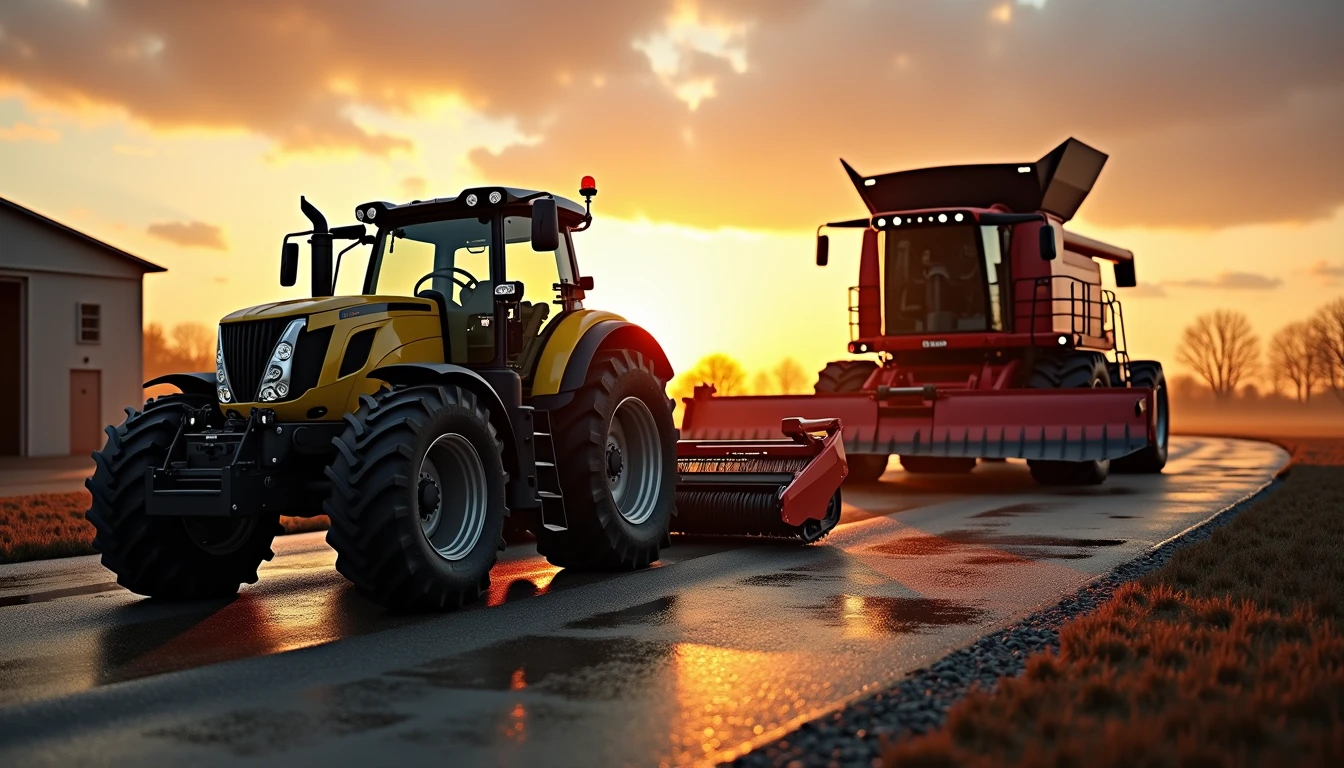
Farm Equipment Categories That Drive Uptime and Lower Total Cost of Ownership
The Big Picture
A guy brought in his farm truck last week—said, “Luis, I’m burning daylight just moving stuff around.” Turned out the real issue wasn’t the truck; it was a mismatch between the jobs on his place and the equipment lineup. On a farm operation, equipment selection is business strategy: the right mix reduces labor hours, improves uptime, and prevents bottlenecks during narrow seasonal windows.
Holt Ag Solutions frames it plainly: modern farmers face a wide range of equipment choices, from basic tractors to high-tech combines, and the “largest investment” typically sits in vehicles. For fleet managers and maintenance supervisors, the takeaway is that standardizing around the right core platforms (especially tractors and their attachments) can simplify preventive maintenance schedules, improve utilization, and reduce total cost of ownership (TCO) by limiting redundant machines.
Key Details
Farming vehicles are the primary capital category
The source emphasizes that among equipment types and uses, vehicles are the most important and represent the largest investment. While pickup trucks are common, farm-specific vehicles—especially tractors and harvesting equipment—are the operational backbone.
Tractors: the universal power unit
Holt describes tractors as “ubiquitous,” with the primary purpose of pulling farm equipment, but notes that modern tractors can be outfitted with multiple attachments to cover “just about any farming need.” For decision-makers, this matters because a tractor-centered approach can consolidate functions into a smaller number of power units—provided the attachment strategy is disciplined.
The source breaks tractors into several categories:
- Compact tractors: Small, high-powered units suited to “basic functions” on a farm or home; ideal for material handling and tight spaces where larger tractors cannot fit.
- Wheeled tractors (utility/general-purpose): Designed to “meet various demands” and be outfitted for tilling, material handling, and equipment pulling. The source notes that these tractors come with a range of horsepower, lifting capacity, control, and cab-style options, allowing buyers to match the machine to applications.
- Track tractors: Use tracks instead of tires, enabling more power for plowing and a smoother ride for the operator.
- Specialty crop tractors: Designed or adapted for orchards and vineyards, with a slender profile to fit between rows of trees and vines while still providing power for landscaping and maintenance.
Shop Trick (three generations): Before you buy “more tractor,” inventory your top three tasks and the attachments you already own. Most overbuying starts when folks spec horsepower first and workflow second.
Combines and forage harvesters: purpose-built harvest capacity
Holt calls out that in northern California and Oregon, combines are commonly used for rice and grass seed, and that combines and forage harvesters can support other farm purposes as well. The key point for operations leaders is that these machines bring mechanized harvesting to operations that might otherwise rely on slower methods—and the source notes that even small-scale farmers can significantly benefit from using them.
Functionally, Holt describes combines as “massive” machines using gears, blades, belts, and wheels to convert cereal crops into grain. It outlines one of the core steps:
- Reaping: Cutting the plant using the header, reel, and cutter bar. The header gathers crops, the reel pushes them toward the cutter bar, and the cutter bar cuts the crop.
Operational Impact
Standardize around platforms to improve uptime
From a fleet perspective, tractors serve as the most flexible platform because they can be “universal machines” with attachments. That flexibility can reduce the number of dedicated machines needed—helping utilization rates and simplifying technician training—if you standardize models and interfaces where possible.
Preventive maintenance scheduling: match the machine to duty cycle
Holt’s breakdown is a practical reminder that duty cycle drives maintenance outcomes:
- Compact tractors working in tight spaces and material handling roles often see frequent direction changes and loader work; that reality should shape inspection routines (linkage, attachment points, and general wear areas).
- Track tractors operating in high-drawbar-load field work are chosen for more power in plowing and improved ride; that selection implies sustained heavy work where disciplined inspections matter for reliability.
- Specialty crop tractors operate in orchards/vineyards where clearance and maneuverability are key; operational constraints can increase the importance of avoiding downtime during time-sensitive passes.
Because the source does not provide service intervals, fuel consumption, or quantified reliability metrics, fleet managers should treat it as a categorization guide—and then apply their internal maintenance history to build preventive maintenance schedules aligned to actual usage patterns.
Shop Trick (three generations): Don’t let attachments become “orphan tools.” Tag and track them like powered assets. If an attachment sits unused, it’s not just idle—it’s tying up capital and storage, and it still needs periodic safety checks.
TCO: avoid duplicative equipment purchases
Holt points out that tractors can be outfitted for multiple needs and are common-sense purchases for both small and large operations. For procurement teams, the operational implication is to:
- Prioritize multipurpose tractor configurations where the same power unit can support multiple seasonal tasks.
- Avoid buying specialized machines to solve problems that can be addressed with the correct tractor category and attachment set—unless the workload truly justifies a dedicated unit.
What to Watch
Operator safety and role-appropriate equipment
While the source does not cite specific regulations, the operational reality is that equipment selection affects safety outcomes. A tractor that is too large for tight spaces or the wrong format for orchard rows increases risk exposure. Match machine type to environment and task, and ensure operators follow site safety rules and equipment operating procedures.
Shop Trick (three generations): If the job site is tight—barn alleys, orchard rows, cramped gates—pick the equipment that fits first, then worry about power. A machine that can’t maneuver safely will cost you more in delays than it ever saves in “capability.”
Market complexity is growing—keep training and parts strategy in mind
Holt notes the expanding range of equipment options and the confusion this creates, especially for newer operators. For established fleets, that complexity shows up as parts variability and training overhead. Standardization and clear use-case definitions help keep mean time between failures from being undermined by mismatched applications and inconsistent operator practices.
Bottom Line
Holt Ag Solutions’ guide reinforces a key fleet truth: vehicles are the largest farm equipment investment, and the right equipment categories—especially tractors matched to job type and purpose-built harvest equipment like combines/forage harvesters—are central to productivity and uptime. For fleet and maintenance leaders, the action is to map tasks to tractor categories (compact, wheeled, track, specialty crop), build an attachment strategy that prevents redundant purchases, and treat harvesting equipment as a capacity decision tied to critical seasonal windows. For anything beyond your team’s mechanical comfort level, take it to a pro—downtime and safety incidents are always more expensive than expert service.