A guy brought his truck in last week, and while I was pulling it into the bay I noticed he had a melted extension cord coiled on the passenger seat. He laughed it off. "It's just for the garage lights," he said. That comment is exactly why I keep coming back to garage electrical safety. A shop, a barn, or even a plain residential garage hides more electrical hazards than almost any room in a house. When you add concrete floors, gasoline fumes, metal workbenches, and a dusty old compressor, the risk multiplies fast. My grandfather taught me to treat every outlet like a loaded tool — respect it, and it will work for you for decades. Disrespect it, and you're gambling the whole building.
Why Garage Electrical Safety Matters More Than You Think
I've seen what happens when a garage electrical problem turns into a fire. It's not a dramatic Hollywood explosion. It's a slow smolder behind a pegboard, with a smell you never forget. On a ranch, you've got hay dust, diesel fumes, and a UTV battery always on a trickle charger. That combination makes garage electrical safety more than a home-shop nicety. It's the difference between losing a workbench and losing everything you built. My grandfather used to say that electricity doesn't care how long you've been doing this. It only cares about the path of least resistance. That path is usually your body, your tools, or your building. Don't make it easy. I've also seen trouble announce itself in small ways: a breaker that trips at odd times, a light that flickers when the welder runs, or an ozone smell that never seems to go away. Each one is a clue worth taking seriously.
The First Place I Look: Outlets, Plugs, and Extension Cords
Walk into any garage and I'll head straight for the outlets and extension cords. That's where most garage electrical safety problems start. Look for discoloration around plug slots, warm faceplates, and scorch marks on cords. If a cord feels hot, don't just swap it — find out why. Usually it's undersized for the load. A 16-gauge cord running a table saw is a classic mistake. I keep 12-gauge cords around for anything that draws real current. Shop Trick: my grandfather wrapped the first six inches of every extension cord with white electrical tape. "Can't see smoke in the dark," he'd say. That tape trick still works 40 years later. Check the plugs too. If they feel loose in the outlet, replace the outlet or the plug. Loose connections create heat, and heat is the quiet killer.
What the Code Says About a Garage
The National Electrical Code might not be the most exciting reading on your workbench, but it exists because people like me made mistakes. The NEC now requires GFCI protection for all 125-volt, single-phase outlets in garages and unfinished basements. That rule has been around long enough that there's no excuse for a garage without them. If your garage was built before the 1990s, there's a good chance it never got updated. I run into this all the time with older ranch buildings. A GFCI outlet costs about $15 to $25 at any big box store, and it literally senses a ground fault before it turns your body into the ground path. That's one of the cheapest insurance policies you'll ever buy for a garage. If your outlets are two-prong or three-prong without that little test and reset button, you're behind the times. Don't beat yourself up, but do fix it. My grandfather told me to put GFCI outlets in the loft of our original shop in 1988, and it still works fine today.

Panel, Breakers, and Flickering Lights
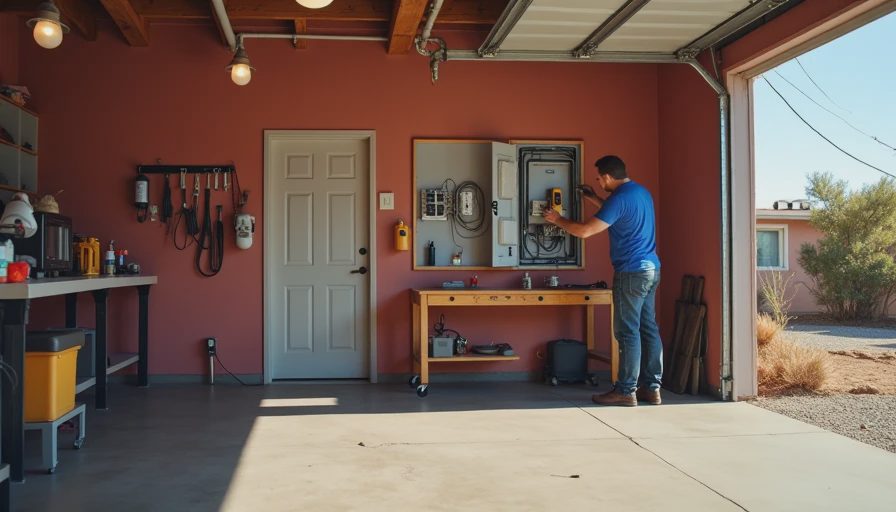
If your garage lights dim every time the compressor kicks on, your panel is telling you something. I see this constantly in Texas shops, especially older ones. The fix isn't always a bigger breaker. In fact, a bigger breaker can turn a wire into a heating element. Breakers are sized to protect the wire, not the equipment. That means a 15-amp breaker is usually paired with 14-gauge wire, and a 20-amp breaker with 12-gauge. If you keep tripping a breaker, the solution is not to swap in a 20-amp when the wire is 14-gauge. It's to run a dedicated circuit. I recently quoted a customer $450 to add a 240-volt circuit for his new air compressor. It wasn't cheap, but it saved his compressor and his panel. Flickering garage lights can also be a sign of a loose neutral in the panel or at the meter. That's a serious problem. If you see sparks or smell burning plastic around your breaker panel, shut it off at the main and call a licensed electrician. If you're not sure, take it to a pro. No shame in that.
A Simple Weekend Routine That Covers the Basics
You don't need to be an electrician to spot the most common garage electrical safety issues. Once a month, I walk through my shop with a checklist and do the same on the ranch. Start by unplugging everything. Feel every outlet faceplate for warmth. Look for burn marks, melted plastic, or cracks. Then check every extension cord from end to end. If you find a cord with a missing ground prong, cut it up and throw it away. There's no safe way to use it. Next, press the test button on every GFCI outlet. The reset button should pop out. If it doesn't, the outlet is dead and needs replacing. Finally, take a look at the back of your workbench. I've found more than one loose wire nut that vibrated off over the years. A simple screwdriver and a few minutes can prevent a shock. My grandfather taught me to do this check during the first rain of the season, right before the moisture starts finding cracks. Still works 40 years later. That's garage electrical safety in practice: a few minutes of attention that keeps your shop running. If your build is older or you've never done this, set aside an hour. It's the cheapest maintenance you'll perform all year.