A guy brought in his truck last week after buying a used tractor that looked clean in the seller's photos. The paint was fresh, the tires were shiny, and the hour meter showed fewer hours than expected. Ten minutes with a pressure gauge and a flashlight found a weak battery, cracked hydraulic hoses, and oil leaking from the rear axle. That is why a used farm equipment inspection checklist belongs in your pocket before money changes hands. A careful inspection can save thousands of dollars and a long, hot walk back from the back pasture.
Start With the Machine Cold
Ask the seller not to warm up the tractor, skid steer, mower, or utility vehicle before you arrive. A cold start tells you more than a polished engine bay. Touch the block and exhaust carefully, then look for signs that the machine was recently run. A warm engine can hide hard starting, excessive smoke, weak batteries, and noisy valve trains.
Record the make, model, serial number, hour-meter reading, and asking price. Compare the serial number with the title, service records, or dealer paperwork. On a tractor, check whether the engine oil is at the correct level and whether the oil looks milky, gritty, or unusually thin. Pull the transmission and hydraulic dipsticks as well. A burnt smell or metal shimmer deserves professional attention.
Start the engine from the operator's seat with the parking brake set and all controls in neutral. Listen for knocking, sharp tapping, belt squeal, or a hunting idle. Blue smoke can indicate oil consumption, while persistent white smoke after warm-up can point to fuel or coolant problems. Black smoke under light throttle often suggests an air, fuel, or injection issue.
Shop Trick: My grandfather taught me this trick — still works 40 years later. Hold a clean sheet of cardboard near the exhaust for a few seconds, without touching hot parts. Soot, oily droplets, or coolant residue can tell you more than a seller's promise that the machine runs fine.
Inspect the Structure, Tires, and Safety Equipment
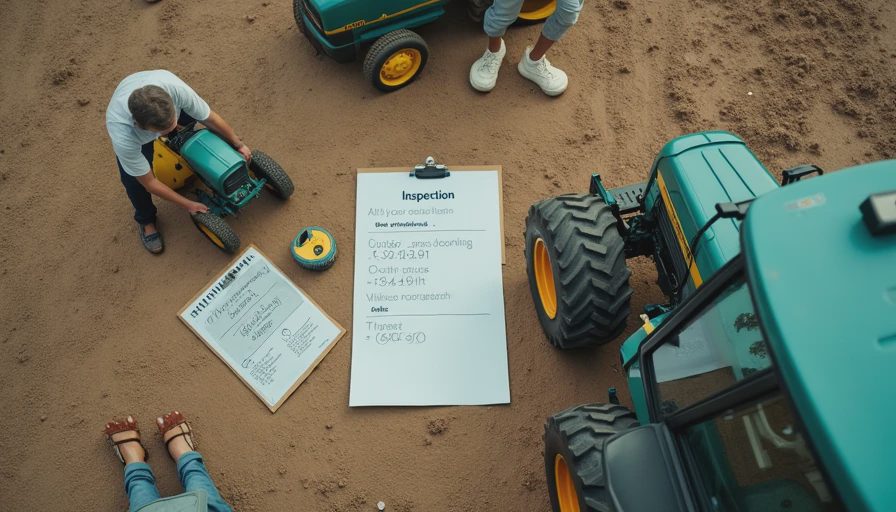
Walk around the machine before operating it. Look underneath the frame, loader arms, mower deck, axle housings, and drawbar. Fresh paint over welds may indicate a repaired crack, not a factory finish. Small surface rust is normal on older farm equipment, but bent metal, stretched bolt holes, and uneven weld beads deserve careful investigation.
Examine every tire for sidewall cracks, weather checking, uneven wear, and plugs. Agricultural tires can be expensive, and replacing a set can easily cost several hundred dollars on compact equipment or well over $1,000 on larger tractors. Check that front tires match each other and that the rear tires have similar tread depth. On four-wheel-drive equipment, mismatched tire sizes can create drivetrain stress.
Test the seat belt, rollover protective structure, lights, mirrors, horn, backup alarm, and emergency shutoff. Never operate equipment with a damaged ROPS or missing seat belt. Keep bystanders away, especially children, and do not climb under raised loader arms or mower decks. If something must be lifted, use properly rated stands and lower the attachment before inspection.
Check Hydraulics, PTO, and Attachments
Hydraulic leaks often start small and become costly. With the engine running, cycle the loader, three-point hitch, steering, and any auxiliary functions slowly. Watch for jerky movement, drifting cylinders, whining pumps, or controls that respond late. Never use your hand to find a hydraulic leak. Pressurized fluid can penetrate skin; use cardboard or a piece of wood and take an injection injury seriously by seeking immediate medical care.
Inspect hydraulic hoses for bubbles, abrasions, exposed reinforcement, and oil around fittings. A replacement hose may cost $40 to $200, but a failed pump, valve, or cylinder can run into the thousands. Engage the PTO only according to the operator's manual, with the attachment clear and everyone standing well away. Listen for bearing noise and confirm that guards are installed.
For a used mower, inspect spindle play, deck rust, blade condition, belts, and idlers. For a baler, check pickup teeth, chains, knotter components, and bale-chamber wear. For a skid steer, examine quick-attach pins and lift-arm play. This used farm equipment inspection checklist is not complete until the attachment is checked as carefully as the engine.
Test the Drivetrain and Controls
Drive the machine at low speed in an open, level area. Test forward and reverse, each range, steering, brakes, differential lock, and four-wheel drive. A tractor that slips, grinds, or jumps out of gear may need more than a clutch adjustment. Verify that the parking brake holds the machine securely, but do not test it aggressively on a slope.
Pay attention to temperature and gauges during a fifteen- to twenty-minute operating period. A machine that starts easily but overheats under load may have a restricted radiator, weak water pump, failing thermostat, or head-gasket problem. Clean packed grass and chaff from radiator screens before testing, but do not assume debris is the only cause of overheating.
On a diesel, look for blow-by from the crankcase breather and excessive pressure at the oil-fill opening. Some vapor is normal, particularly on an older engine. Heavy pulsing smoke or oil mist suggests wear that requires compression testing. Compression tests, hydraulic pressure tests, and electronic diagnostic scans are good jobs for a qualified technician if you do not have the right equipment.

Review Records and Calculate the Real Price
Ask for maintenance invoices, engine-hour history, parts receipts, and previous auction or fleet records. A missing manual is not a deal breaker, but it makes safe operation and parts identification harder. Search the model's common failure points through a dealer or reputable equipment forum, then price the parts before negotiating.
Build a repair allowance from what you found. A battery may cost $100 to $250, a set of filters perhaps $50 to $200, and four compact-tractor tires several hundred dollars. A clutch, hydraulic pump, transmission repair, or engine rebuild can turn a bargain into a $5,000 to $15,000 project. Subtract realistic repair costs from the seller's price, and leave room for fluids, seals, transport, and unexpected fasteners.
Do not let a low-hour meter settle the question by itself. Hour meters can fail or be replaced, and operating conditions matter. A tractor used for loader work may experience more hydraulic and drivetrain wear than one used for light mowing. Compare pedal wear, seat condition, steering-wheel wear, hitch wear, and paint loss with the stated hours.
Make a Safe Buying Decision
Use the used farm equipment inspection checklist twice: once before starting the engine and again after the machine has worked. Oil leaks that appear after warming up, temperature problems under load, and hydraulic drift may not show during a quick walk-around. Bring a flashlight, gloves, clean rag, tire gauge, screwdriver, cardboard, phone camera, and a notebook. Bring a knowledgeable friend when possible; a second set of eyes catches details that excitement hides.
If the seller refuses a cold start, operating test, serial-number check, or independent inspection, treat that refusal as information. Do not crawl beneath an unsupported attachment or remove pressurized components in a driveway. If you are not sure, take it to a pro. No shame in that. A dealer or agricultural-equipment technician can perform pressure testing and computer diagnostics that a basic visual inspection cannot.
Before signing, confirm what comes with the sale, including buckets, forks, remotes, weights, manuals, keys, and spare parts. Put the serial number, price, condition, and promised repairs in writing. A good machine should fit the work, budget, and skill level of the owner. That is the heart of a used farm equipment inspection checklist: buy the equipment you can verify, not the story painted around it.