A tractor on a slope can shift as surely as a calf leaning against a gate. That’s the picture I want you to have in mind when weighing tractor jack vs lift safety: neither a jack nor a shop lift is automatically safe just because it can raise the machine. For a wheel or brake job, a properly rated jack and compatible support stands are often the practical choice. For work underneath, a lift designed and rated for the specific tractor can offer better access, but only when its manufacturer permits that load and setup. Never crawl under a tractor supported only by a hydraulic jack.
Choose equipment for the tractor and the job
For a compact tractor owner who occasionally removes a wheel, a heavy-duty hydraulic floor jack from a manufacturer such as Hein-Werner is one line to investigate, paired with appropriately rated stands. For a shop considering a drive-on setup, Rotary Lift is a manufacturer with vehicle lift lines worth investigating. Neither brand name is a blanket approval: the particular jack, stands or lift must be rated and approved for your tractor, its weight distribution and the intended support points.
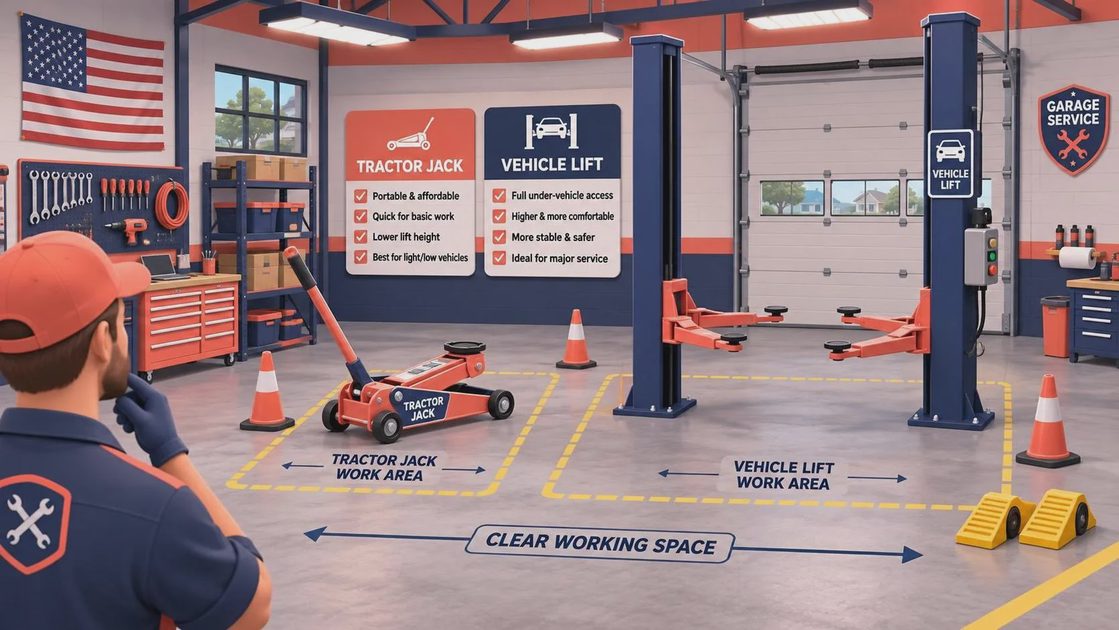
A jack takes less room and can be the sensible tool for raising one end. Its limitation is stability: you must find approved lifting and support locations, prevent rolling and account for the tractor’s pivoting axle. You also need enough room to place stands without crowding the jack.
A suitable lift can give a technician more working room, but tractor clearance, wheelbase, track width, center of gravity and attachments can make an ordinary automotive setup unsuitable. Don’t assume a two-post lift that handles a heavy pickup is approved to hold your tractor. Check the lift manufacturer’s instructions and contact the manufacturer if the application isn’t clear.
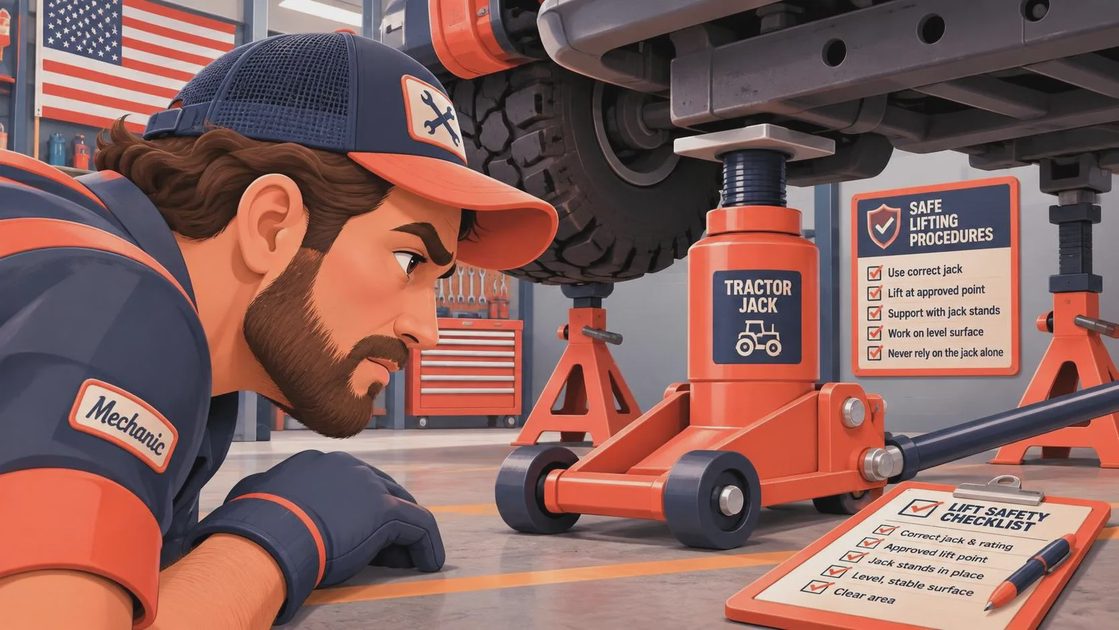
Tractor jack vs lift safety starts with the actual load
Find the tractor’s operating weight in its manual, then account for the loader, ballast, filled tires, implements and anything else that will remain on the machine. Published base weight alone may leave a lot out. A loader can put substantial weight over the front; a rear implement can change the balance in the other direction.
Compare that load with every relevant rating: jack capacity, stand capacity, lift capacity and any individual arm, axle or runway limits specified by the manufacturer. A lift’s total capacity does not mean each arm can safely carry the full rating. Likewise, read how stand capacity is stated and follow the stand maker’s instructions rather than assuming any two stands can share a load evenly.
Shop Trick: Before touching the handle, sketch the tractor, its heavy attachments and the proposed contact points on a scrap of cardboard. My grandfather taught me this trick — still works 40 years later. The sketch won’t calculate axle loads, but it makes an awkward reach or an unsupported side easier to spot before the machine is in the air.
If you can’t establish the weight, approved contact points or equipment capacity, stop and call a tractor dealer or qualified equipment service shop. Guessing at a load is not a way to save money.
Set up a jack and stands on solid ground
Work on a firm, level surface. Packed dirt, gravel and hot asphalt can shift or give way under a concentrated load; a piece of scrap plywood is not a substitute for a suitable supporting surface. Use wheel chocks on the wheels that remain on the ground, following the tractor and chock manufacturers’ guidance. Set the parking brake, shut off the engine, remove the key and follow the manual’s instructions for lowering attachments and relieving hydraulic pressure.
Use the tractor manufacturer’s designated lifting points. Place the jack squarely, raise the machine only as high as needed, and position properly rated stands at approved support points. Lower the tractor carefully onto the stands. Keep your body out from underneath while placing them, and confirm the load is securely supported before beginning work.
A common front-end problem is an axle designed to pivot over uneven ground. Raising the center does not necessarily stop the tractor from tipping sideways around that pivot. Follow the tractor manufacturer’s procedure for stabilizing it; if you don’t have an approved method and the right equipment, take the job to a pro. Never improvise with loose blocks or stacked bricks.
What changes when you use a lift?
Start by confirming that the lift manufacturer permits the tractor’s configuration. On an arm lift, the arms and adapters must reach approved points without interference and stay within their individual ratings. On a drive-on lift, the tires must sit correctly on runways that accommodate the tractor’s width and wheelbase. The lift must also have the clearance and capacity for the complete machine.
Remove or secure attachments only as the tractor and lift instructions allow. Changing the load after raising can shift the center of gravity, so plan major component removal with the equipment manufacturer’s guidance and use additional supports where specified. A loader, counterweight or wheel assembly is not just extra weight; taking one off can change the balance of what remains.
Raise the tractor a short distance first, stop, and check the contact points and stability from a safe position. Then raise it to the working height and engage the lift’s mechanical locks according to its instructions. Don’t depend on hydraulic pressure alone, and don’t work beneath a machine that shifts, sits unevenly or contacts the lift in an unapproved location.
Know when the job belongs in a shop
A tire change can become a heavy-equipment job quickly when a wheel is ballasted or a fastener refuses to move. Splitting a tractor, removing a loader or working around a large suspended implement calls for specialized supports and procedures. Hydraulic leaks under pressure also present an injection hazard; keep hands away from suspected leaks and seek immediate emergency care for a suspected injection injury.
Before lowering, clear tools and people from the area, check that the ground and landing points are clear, and follow the equipment’s lowering sequence. If the tractor has shifted on its supports, don’t reach underneath to straighten them. Stop and get qualified help.
The neighborly answer is simple: match the equipment to the actual tractor, support the load mechanically, and leave the work alone when the setup doesn’t feel right. If you’re not sure, take it to a pro. No shame in that.